Four Most Common Myths About Holy Orthodoxy
I have been meaning to write this article for a long time, but the other night I smoked cigars with someone who expressed all four of the most common myths about Orthodoxy, and this is as good a time as any. I certainly wouldn’t pick on my guest – he’s to be congratulated for summing up the most common misinformation and lauded for rightly identifying that, if those myths are correct, Orthodoxy is certainly bunko. But since we hear this stuff all the time, it’s handy to take that set of myths and put down my own response to them in the hopes that, once I blog it, I won’t have to keep doing it. So thanks to the unnamed person who knows who he is, and here goes:
 MYTH 1: There are two types of Orthodoxy – Russian and Greek Orthodoxy – that are religiously different. Another way to put this is “Orthodoxy is a federation of national(istic) or state churches based on ethnicity”, which you will even find in some encyclopedias of religion. Even some Orthodox perpetuate myth, which is based on a heresy (phyletism – that is, raising ethnic culture above religious identity). It’s easy for those born in Protestant countries to become confused about the reason, origins, and character of local religious traditions and misconstrue this as a different “denominations” or Orthodoxy. In fact, all Orthodox, bar none, may commune in any Orthodox Church. Another way to put that is that there is one Orthodox Church only, and all churches together are that Orthodox Church, whether the Jerusalem Patriarchate, the Greek one, the Russian one, the Romanian one, or the Orthodox Church of Korea. Anyone who tells you different is either being dishonest or just ignorant, and surely you aren’t surprised if ignorance is a commonplace trait in the world. Actually, to claim such a thing is to utter a heresy, and any Orthodox person saying it should know better. I happen to participate in the Orthodox Church of America (the OCA). But when I’m traveling, I will go to whatever Church is where I am traveling. If in the Ukraine, I will go to the Ukrainian Orthodox Church. A lot of people frankly have just assumed that because one Church tends to name its kids for Saints and another tends to do it for Religious Events or Ideas, or because one Church eats dumplings on Pascha and another eats grape leaf rolls, they’re different in some fundamental way. And there are people with common bigotries that grow up in any religion and may express those as “Oh, those Russian people are all screwed up, I’m Greek – or vice versa”. Orthodoxy looks upon this as “silly talk”, which is not to say it doesn’t happen. The notion, also, that all Orthodox Churches (or even most) are Russian or Greek is patently silly. The Apostles founded churches all over the world, notably in the East, but also in the West, and for instance the Patriarchate of Egypt (the Antiochian Orthodox Church) isn’t some kind of subset of either Russian or Greek Orthodoxy. Precisely, the terms “Russian Orthodoxy” and “Greek Orthodoxy” themselves give the wrong idea to English speaking people, because English speaking people are coming from a context of Protestantism, where a religious designation refers to a distinction in religious belief that results in a difference of denomination rather than speaking of merely a distinct administrative reality, like the location of whichever Patriarchal throne, which is more like a distinction between states under the Articles of Confederation. A diocese and the diocesan governance in the Church is actually simply adopted from a) the legal administrative districts of the Roman Empire, and b) those places where the Apostles or their successes founded a new diocese. There’s really no such thing as either Russian Orthodoxy or Greek Orthodoxy in a religious/doctrinal sense, that is if you are thinking of religious doctrine. There is a Russian Orthodox Church in that Russia has a Patriarchate, but not in the sense that it has a Russian doctrine. The same with Constantinople, Alexandria, Antioch, Jerusalem, Bulgaria, Georgia, Serbia, and Romania. These are all distinct Patriarchates, which are administrative distinctions, but not religious or doctrinal ones.
MYTH 2: The Orthodox Church is an offshoot of the Roman Catholic Church. This implies, really two things – that the Roman Catholic Church precedes all others in time, and that the Orthodox Church is essentially a Protestant phenomenon – a “protest” movement (today we might call it a breakaway or separatist movement, or even a nationalist movement) against the Roman Catholic Church. This isn’t historically accurate at all. For the first 1000 years of Christianity, there was one Church. It was, by Creed: “One, Holy, Catholic, and Apostolic”. The Church was conciliar (that is, it relied on Ecumenical “Councils” to distinguish its doctrine from heretical movements), and collegial (meaning all Bishops, including all Patriarchates of the Church were equal in what the West would later think of as “authority”, though that concept really only took shape as part of the much more recent Roman Catholic claims of “papal authority”, for obvious reasons). In short, all Patriarchs were popes (it means “papa”), and all patriarchs, with their people, constituted the fullness of the Church on earth, in their dioceses. To illustrate this, when the Roman Patriarch tried to assert authority in the sense of control over all the others, the other Patriarchs told him the Apostles had consecrated bishops and founded dioceses all over the Mediterranean East (primarily, in fact), while the city of Rome had become a lonely backwater in the West, overrun by Goths, with very little left. For all Patriarchs (Patriarchs are Bishops of first honor) of the Orthodox, even a Bishop whose diocese was the size of Norman, Oklahoma was as much a Bishop with the same “authority” as a Bishop whose diocese spanned a territory the size of Texas. The break came 40 years before the “Great Schism”. In 1014, the Orthodox began to remove the Roman Patriarch’s name from the diptychs, which are the prayers for Orthodox bishops. This indicates that whatever the Roman Patriarchy had become, it was no longer regarded as what the other Patriarchates remained – it was thought of as having departed from Orthodoxy, as no longer being conciliar and collegial in some way. In 1054, the emissary of the Roman Patriarch “excommunicated” the Patriarch of Byzantium in a last ditch effort to assert “authority” over other Patriarchates, but this was of course ignored by all other Patriarchs in the world. It was after this that, to distinguish themselves from the radical changes being implemented by the newly dubbed “Roman Catholic Church” (a religion no longer collegial and bound by the Seven Councils, but one that now had only one head and that had began having its own innovative councils), the other Patriarchs adopted the term “Orthodox” from the Church’s own tradition. While Orthodoxy remained Catholic in fact, the Roman Catholic Church became merely Roman (i.e. merely national) and therefore no longer catholic at all. The term “Orthodox” showed that the Church was originally and is still collegial and conciliar, and cannot be parceled off into individual movements of control, whatever they may be called, and whatever might be used to justify it, nor can it be turned from a college of equals into a hierarchy of one global dominion. For the Orthodox, the Roman Catholics are the first Protestants, a merely nationalistic/imperial movement in the West, and the father of the 50,000 Protestant denominations that exist today as likewise non-conciliar, non collegial (and therefore non-Catholic and non-Orthodox religious groups). One last note: The terminology isn’t a trick – all Patriarchs (not only the Roman one) are rightly called “pope” which means “papa”, which is why even the Copts in Egypt refer to their patriarch in this way (e.g. the recently reposed Pope Shenouda). Likewise, the Orthodox venerate, make icons of, and consider some “popes” of Rome, before 1014, as Church Fathers, precisely because, at one time, Rome was actually Catholic and actually Orthodox, because there was only one church, which was that of the Seven Councils and the college of all bishops. Notable, for instance, is Pope St. Leo the Great – i.e. a Patriarch of Rome.
MYTH 3: The Church innovated its fundamental beliefs and doctrine at the Council of Nicea. Does one really think that all the Bishops of the world showed up and came to agreement in a few short years over something they were “inventing”? Anyone who has seen Protestant denominations try to reduce instead of expand their divisions knows that’s not likely, and they have far less to agree or disagree about than a Church with an extensive historical, liturgical, iconographic, hymnographic, hagiographic, and intellectual tradition. At Nicea, which is only the first of the Seven Oecumenical Councils, all of which are equally binding, the Church expressed what it already believed and already was doing the world over, including the Creed that had already been said for 200 years, and merely agreed on the standardized language that would mitigate minor differences in local expression, so they could distinguish the Orthodox Creed from that of heretics. In fact, the Creed predates the New Testament Scriptures and is even quoted in early form in the Holy Scriptures, just as are sections of liturgy, including numerous hymns, as well as pagan philosophers, well known stories, and even other Christian writings. It’s silly to act as if things happened in a vacuum. Just as there had to already be (logically and historically) a global community living and practicing the things it wrote about in its own scriptures, in order to write those scriptures, so it had to exist and be living and practicing the things it agreed were proper at one of its earliest Church councils. Incidentally, the first Church council, which isn’t ecumenical but local, was called by the Apostles and is recorded in the book of The Acts of the Apostles, which is Scripture. Nicea didn’t even invent church councils! But if you really want to know what did occur at Nicea, the minutes of the Council are available – why guess?
MYTH 4: The Orthodox Church, like every Church, claims to be the original one founded by Christ, so there’s no way to know that. Actually, every church does not claim that at all. They claim to be living in the same manner as the first Christians, to have adopted the same beliefs, or to be likewise following Christ. They do not, and cannot, credibly claim to be the actual physical, historical Church founded by Christ. To do that takes substantial evidence that a) Christ actually founded a Church, b) that Church is historical, not intellectual or one of mere personal affinity, attitude, and intellectual belief, and c) it requires documentation of who consecrated every Bishop of that Church in succession from Christ, through the Apostles, their successors (like St. Timothy), their successors, and so on, down to every single Bishop of the Church today. Simply popping up and claiming to be “Christian” or to be “the Church” isn’t the same by any stretch, which is exactly why, of course, we’d keep track of that stuff. In fact, the idea that the Orthodox have to make “claims” is inherently Protestant, and is the kind of language used by Protestants. It assumes religion by religious archaeology, an attempt to recreate something, like a Civil War reenactment, rather than something that has never ceased to exist in the first place. After all, if you’ve been doing the same things since the beginning, you don’t have to make “claims”, you can simply continue being what you were and let those who pop up and invent new “versions” make all the claims. For the Orthodox, you either belong to Orthodoxy, or you do not. If you like the Apostle Paul, join his Church. If you believe the Scriptures, great, we wrote those. It should be pointed out that a variation on this particular myth is the idea that Orthodoxy came into existence only 2000 years ago. While again that is what is said by a lot of Protestants about their own religion, their own “version” of Christianity, which is based on drawing a distinction between themselves and Israel, who they regard as a continuing and separate people of God, the Orthodox deny this distinction. In fact it would be a heresy to claim that there is a continuing “people of God” based on ethnicity, because Christ has come and become the fullness of all mankind. Actually, the Orthodox consider their religion the original religion of man (e.g. St. Adam and St. Eve), and the Orthodox themselves the Israel of God, the continuation of the Israel who awaited and then received the Christ or “Messiah”. Saints Abraham, Isaac, and Jacob are our fathers as readily as St. John Chrysostom. We think of ourselves as the people God led out of Egypt and through the wilderness, for which reason anyone who has listened to the annual liturgical cycle knows our prayers are replete with such language, and our religious calendar is choc-a-bloc full of this history and these events as feasts and fasts among our people. Likewise our Churches are resplendent with the iconography of this history and these events, while our temple looks for all the world like the Temple of Solomon, gold implements and all. The Gospels are venerated when carried from the altar as the Torah was when carried from the Ark. Baptism is the new Circumcision. For us, the Mother of God is the Ark of the New Covenant bearing within her Christ the Law who becomes written on our hearts. She is the bush that is burned and not consumed, since God is born of her and she is not obliterated. Our understanding of our history isn’t a mere 2000 years old. We hear God talking to us in the person of Moses of the coming Christ. As far as we’re concerned, Israel *received* her King, and therefore we are his people. There is no St. Paul without St. David. The ancient genealogical succession at the beginnings of our Gospels is fulfilled in Christ who creates in himself the apostolic succession fulfilled in the Church, and so we do not merely “trace” our lineage to the beginning, as though we were trying to dig something up or resurrect or recreate it, but we have never ceased to continually *be* the people of God, historically and really. We don’t go around “claiming” it, in that sense; we just keep being it. And if people don’t wish to “believe” that, it’s fine. We aren’t really a belief system, per se, anyway, in the sense that we need to have a lot of people “accept” what I’m telling you about. We’re historical, visceral, ascetic. Anyway, in that case, Peace. Go your own way. Make up your religion, if you want. I think some of us wish you would just do it from scratch, instead of taking our stuff all the time. It’s kind of “Ozzy”. Give us our books back, and write your own. That would be cooler.
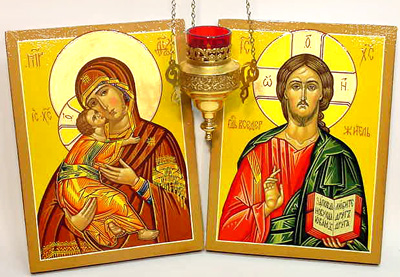 – Praying along with all the prayers is the norm, even with most of the prayers that are said by the Priest or Reader, with our lips moving and breathing the words almost silently. Some words are back and forth or augmented or completed by us, so the priest says something and we say something in response, just like Psalms are sung antiphonally. The most common response occurs in the many litanies, and that’s “Lord have mercy”, which we pray ad infinitum.
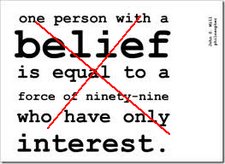 It seems a peculiarity of the dominant culture in the US that beliefs are accorded the status of conviction, something just a hair shy of “reality”. I blame a lot of fighting on this. I regard beliefs as trivial. I have them, but they’re more like suspicions, guesses, bets, mental gossip. When I say “I believe that x is so” – I don’t mean I’m willing to fight and die for the insistence that it occupy the status of reality for other people, that I need it to dominate all competing guesses about reality. But that’s exactly what a lot of people are doing with the attitude of “belief”. I regard beliefs as ephemeral.
 When other animals get sick, the first thing they do is stop eating – they fast, in other words. Fasting is an acknowledgement that, as all the Fathers have taught us, we are fundamentally sick with the disease of Death. Not to fast is to deny the most basic truth of our Faith, that we have become separated from God, and is to deny the example of God himself, who became man to unite us to himself, and who likewise fasted and still does fast. As St. Seraphim says, he who does not fast does not really believe in God. Certainly, he does not believe in the “god” we mean when we say that word.
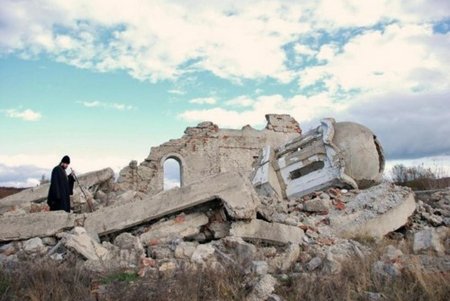 There are always people who choose to swallow whatever official line is issued. Our livestock-like lives require it as we sit in our cubicles, our pews, our sofas and lawn chairs, our various slots in the established order. We set our minds aside, we set aside the cries of those dying around us, and we nod like bobble heads: “there’s no evidence of government wrongdoing”, “the West is not responsible”, “it’s an indiscernible mess that can’t be sorted out or meaningfully understood”.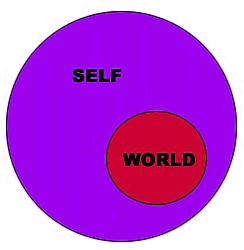

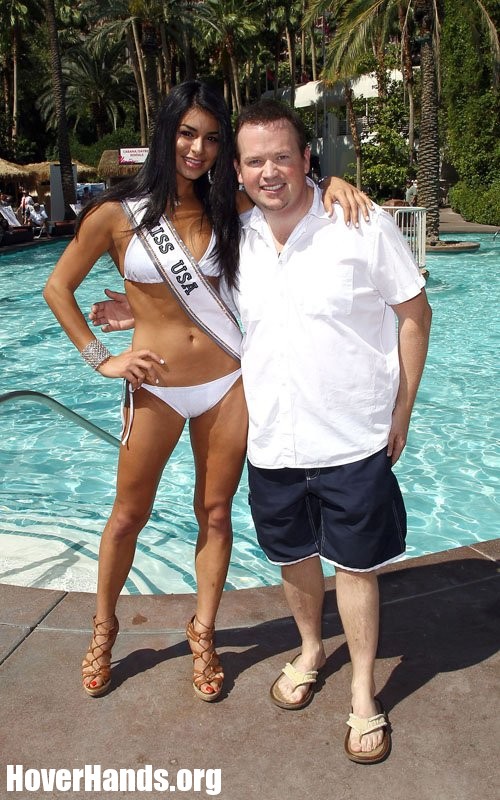 When you look at photos of virgins, often, they are doing the hover-hand thing with the women in the photo. Maybe it’s not virginity per se, but it’s a certain delicacy in handling women – a sense that she might be outraged and the embarrassment or other social penalties extreme for touching her without her express consent (at least that’s the theory – I think it’s also that touching is an intimate thing – a truth, there – and his feeling is that she’d reject intimacy – but photos extort people into pretense situations – forced to smile – forced to stand close). Let’s go with the theory, tho. If you’re in a photo with me, and we’re getting in tight for the camera, my hands are going to be on you. Hips, shoulders, maybe even a bit of neck. I’ll fit right into the nearest curve. I try to stop short of thighs, even though I’m really comfortable with it. I find that a lot of skeptics about truth are simply virgins when it comes to it. Not that they haven’t experimented with truthyness. But joining an evangelical cult, sitting in the back of a Methodist Church, or being active in a political movement isn’t really the same thing – it’s more sex with a sheet up – it’s truthyness. Strategery. It’s like the WMDs in Iraq (now Iran). We know they’re there, but that isn’t the truth. The truth is who we are as a people that we still want to want to decide to decide to believe what people want us to in order to not have to face up to what we are. Strategery is truthyness is strategery.
 Isn’t it odd, though? Try to deny it. Isn’t it odd that what the Koran is, as holy book, to fundamentalist Islam, so the US flag is to fundamentalist neoconservatives in the US. Not the bible or the cross, but the flag. Is that not telling as to what that religious and cultural persuasion has become? You could go on – Reagan could be their Mohammed – etc. But the flag – that’s truly the corpus of worship in the predominant religious movement in the US. It’s really “me”-ness in all it’s forms. Whiteness. My truckness. US-ness. My politicsness. My personal philosophyness. It’s the ultimate cult of self-worship. The flag is merely the best external symbol that represents simultaneously me-ness and the collective, homogeneity-ness – the us-ness. For the fundamentalist neoconservative, the US flag is the ultimate resolution of the perceived contradiction between the one and the many, monism and pluralism. It is the prime talisman of the social attitude.
 “It is shameful to be proud of the adornments that are not your own, but utter madness to fancy one deserves God’s gifts. Be exalted only by such achievements as you had before your birth. But what you received after your birth, as also birth itself, God gave you. Only those virtues which you have obtained without the co-operation of the mind belong to you, because your mind was given to you by God. Only such victories as you have won without the co-operation of the body have been accomplished by your efforts, because the body is not yours, but a work of God.” – Saint John Climacus
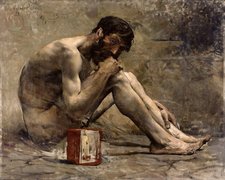 For me, epistemology, judgment, and identity are the core variables that determine whether I engage people seriously or merely humour them.
 The answer is simple. I respect things that have a long tradition – either of development or of sustained and resilient meaning. That’s not what I see in a lot of pop music nor in most pop religion, each of which are rife with ill-advised fads – like the mullet which, for a time, was supported by both, to mention the least embarrassing example. I’m not an Anglican, but no one can witness the prayer of humble access contritely offered and scoff, except a small-minded buffoon. The same with the cycle of Holy Week liturgics in the Church of the East. And I’ve never seen a child left hungry, or a mother deprived of a coat in one of those rural, full gospel black congregations.
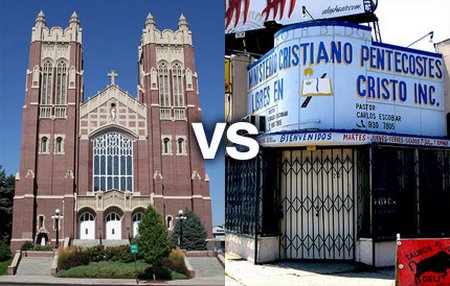 When some people ask about my religion and, and I mention our traditions, they express surprise because I wasn’t raised in it. Their point is that, if you didn’t grow up in the Faith, speaking of “my people” or “our tradition” seems false or contrived. It has taken me some years to realize that, because they are inundated with fundamentalist ‘messages’ from every megaphone the world offers, they have never grasped the core concepts of actual Christianity.
 We live in an age of AntiChrist. I don’t mean a fundamentalist theory that plays “who’s the devil”. I mean in principle, politically, and ethically, it’s one of the ages of AntiChrist, of which there have been many – perhaps (as is my attitude) all of them. There are several core principles of AntiChrist or of an antiChristian ethos, many of which are supported fervently and even rabidly by the loudest and most obnoxious of those who pretend to be “Christians”, i.e. the evangelical right.